
The Decade of White Oak: Deciphering North American Hardwood Grading and Market Dynamics
Over the past decade, White Oak has undeniably established itself as the absolute baseline and premium standard within the North American high-end furniture, architectural millwork, and luxury surfacing sectors. Among its various structural and aesthetic variants, Rift Cut Veneer has reached near-unprecedented levels of reverence. Celebrated for its uncompromising minimalism, ultra-clean linear alignment, and serene architectural grain patterns, it has become the signature canvas for modern luxury interiors.
However, an objective look at the supply chain reveals a stark commercial barrier: the market price for authentic FAS or Select & Better (S&B) solid White Oak lumber is often multi-fold that of standard common grade (1C) options. Consequently, specifying solid premium-grade material across entire architectural projects remains a privilege reserved exclusively for ultra-high-end luxury hospitality environments and bespoke residential commissions with uncompromised budgets. For high-volume, mainstream product lines or value-engineered developments, solid FAS lumber remains entirely out of reach. To navigate this economic landscape, understanding the formal classification, structural traits, and price hierarchies of North American White Oak is paramount.
| Characteristics | FAS | S&B (Select & Better) | S&B Quartered | S&B Rift |
|---|---|---|---|---|
| Classification Nature | Official clear-face yield grading standard. | Commercial proprietary blend grading standard. | Yield standard combined with quarter-sawn radial ray alignment. | Yield standard combined with precise rift-sawn comb grain alignment. |
| Two-Sided Requirements | Both faces must independently meet the highest clear-grade standards. | The face side must be structurally perfect; the reverse side permits #1 Common defects. | The face side must be perfect, the reverse side allows minor flaws; must display linear straight grain. | The face side must be completely flawless, the reverse side allows minor flaws; must feature exceptionally clean, straight comb grain. |
| Visual Texture | Dominated primarily by prominent cathedral grain structures (Plain Sawn), unless explicitly specified otherwise. | Dominated primarily by traditional cathedral patterns and prominent Plain Sawn structures. | Features strong parallel straight grain integrated with highly pronounced medullary ray flecks (Ray Flecks). | Exhibits ultra-clean, tightly parallel straight comb lines completely devoid of medullary ray flecks. |
| Physical Stability | Moderate. Plain sawn structures are naturally more susceptible to cupping and twisting under relative humidity fluctuations. | Moderate. Dimensional stability depends significantly on the grade and orientation of the reverse face. | Exceptional. Radial grain expansion occurs strictly along the thickness rather than the width, maximizing flat structural integrity. | Extreme. Offers the highest structural stability across all cuts, exhibiting virtually zero twisting or bowing. |
| Yield & Waste Metrics | High log utilization rate; standard efficiency during primary sawing. | High log utilization rate; delivers optimal commercial cost-to-benefit performance. | Requires highly specialized log-turning techniques; incurs significant log volume loss and high waste ratios. | The least efficient sawing method available; generates the highest waste volume and the lowest overall yield per log. |
| Price Ranking | $$ (Baseline Premium) | $$-$$$ (Slightly below or competitive) | $$$$$ (High Premium, 30-50% over FAS) | $$$$$$ (Maximum Premium Surcharge) |
| Common Applications | High-end solid wood furniture and artisanal luxury crafts where both faces remain fully exposed. | Premium cabinetry doors, single-sided veneer layups, and architectural wall paneling where the back face is concealed. | Traditional American Craftsman furniture (Mission Style), ultra-premium hardwood flooring, and historic wine cooperage. | Modern luxury minimalist cabinetry, high-end bespoke architectural millwork, and luxury musical instrument components. |

3A Grade White Oak Wood Veneer | Beyond FAS Premium Standard
Discover ultra-premium 3A Grade White Oak wood veneers. Sourced directly from Indiana & Ohio, surpassing FAS standards. The ultimate choice for luxury architectural millwork.
When the Market Demands Perfection, Efficiency Rewrites the Rules
In the upper echelons of premium woodworking, an ancient principle holds true: as architectural specifications grow more demanding, manufacturing ingenuity must evolve to match them. When high-end hospitality brands and bespoke cabinetry designers demand flawless, ultra-pure rift-cut White Oak for wide-spanning elevations, manufacturing facilities are instantly forced to confront immense raw material costs. In this high-stakes equation, premium architectural wood veneer emerges as the definitive, ultimate solution.
The finest, straightest White Oak logs harvested from the prime terroirs of Indiana and Ohio are rarely routed to standard sawmills for conversion into solid lumber. Instead, they are fiercely secured by global veneer conglomerates such as M. Bohlke Veneer and Danzer, alongside elite regional slicers like Phu San in Vietnam. Within these advanced facilities, the highest-tier logs are processed into ultra-thin, structurally sound sheets measuring between 0.3mm to 1.2mm. By converting rare, slow-growth timber into micro-thin architectural veneer rather than thick solid planks, the industry maximizes the aesthetic footprint and commercial value of an increasingly scarce natural resource.

Slim Shaker Oak Kitchen Cabinet | Rift Cut Veneer Style
Modern Slim Shaker kitchen cabinets engineered with premium Rift Cut Oak veneers. High-end linear grain with extreme dimensional stability. Perfect B2B solution for multifamily developments.
Strategic Implementation in Modern Premium Cabinetry
In the highly competitive landscape of Vietnamese RTA (Ready-to-Assemble) manufacturing, factories tasked with delivering a flawless rift-cut White Oak aesthetic must balance pricing competitiveness with strict Western quality expectations. Forward-thinking manufacturers rely on three distinct structural engineering methodologies to resolve this challenge:
- Full Architectural Rift Cut Veneer Encasement: The core substrate is constructed using sustainable, highly stable plantation rubberwood finger-joint panels. All exposed faces are overlaid with premium rift-cut White Oak veneer, and all four perimeter edges are sealed with matching 0.5mm veneer edgebanding. This engineering approach is exceptionally well-suited for crisp minimalist geometric profiles, such as slim shaker or traditional flat shaker profiles. However, it cannot be applied to complex stepped details like double shaker or step shaker designs. This delivers the lowest production cost, though the ultimate depth of texture remains bounded by the veneer layer.
- Zonal Premium Veneer Overlays on Solid Substrates: The foundational framework utilizes cost-effective #1 Common (1C) grade solid White Oak. For components presenting severe natural color variations, heavy mineral streaks, or prominent medullary ray flecks on the prominent face, the factory performs a secondary precision sanding and overlays a premium rift-cut veneer skin. This intermediate strategy balances material cost while ensuring a uniform, ultra-premium exterior appearance that satisfies rigorous visual inspections.
- Pure Solid S&B / FAS Grade Construction: The entire cabinetry component is manufactured exclusively from premium solid Select & Better or FAS grade White Oak lumber. This method avoids all engineered cores and composite veneers, yielding an uncompromised, heirloom-quality solid wood product. Because of the astronomical raw material costs and high rejection rates during matching, this tier commands an elite price point and is reserved strictly for artisanal, high-end custom boutique collections.
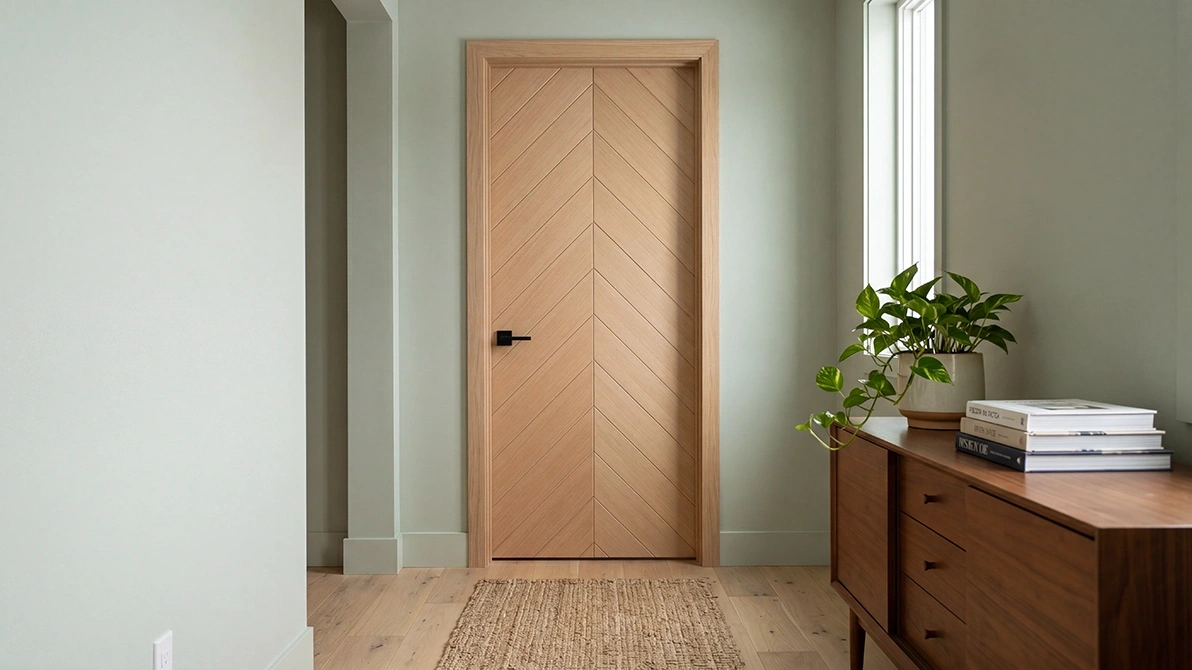
Modern Chevron Interior Door | Premium Wood Veneer Style
Engineered modern Chevron pattern interior door utilizing premium natural wood veneers. High-end geometric V-grain design with zero warping risks. Ideal B2B solution for luxury multi-family projects.
Architectural Evolution in Interior & Exterior Door Engineering
Solid wood passage doors serve as an essential structural and aesthetic anchor in North American residential design. As the market’s obsession with White Oak continues to surge, multi-family developers and production builders must integrate premium White Oak options into their architectural door packages. However, architectural doors typically demand a substantial thickness specification of 1-3/8” (compared to standard 3/4” cabinetry doors). Utilizing solid, un-engineered FAS White Oak across a massive slab creates prohibitive costs that prevent it from scaling as a commercially viable option. To bridge this gap, the engineered solutions pioneered by Chan Tam Wooden Door provide an optimized path forward:
1. Engineered Reeded & Detailed Slab Doors
The interior structural core utilizes a high-density, flat-grade Particle Board compliant with rigorous CARB Phase 2 emission standards. The entire perimeter is completely bounded and protected by a robust solid wood band of FAS-grade White Oak. To achieve the deep, structural fluting and modern linear three-dimensional channels demanded by contemporary architectural styles, the core undergoes precision CNC routing. Solid strips of premium FAS-grade White Oak are meticulously embedded into these routed channels. Because this process introduces structural height variations, the entire assembled surface undergoes primary heavy-duty wide-belt sanding. Next, a premium 0.6mm 3A-grade rift-cut White Oak veneer sheet is permanently bonded across the entire face. Finally, the door is returned to the CNC machining center, where specialized profiling cutters re-route down into the exact coordinates of the embedded solid wood inserts. The result is a striking, deeply profiled reeded interior door that perfectly balances structural stability, luxurious depth, and commercial feasibility.
2. Engineered 5-Piece Stile & Rail Doors
Mirroring the structural stability of the slab door, the structural stiles and rails utilize an engineered CARB P2 particleboard core. Each individual stile and rail component is wrapped in a solid White Oak protective layer, undergo primary calibration sanding, and are subsequently skinned with premium rift-cut veneer. Once the individual components have achieved a flawless surface finish, they are structurally assembled. The intricate inner profiles are then precision-fit and hand-fitted by master craftsmen, ensuring seamless, tight joinery across all architectural transitions.
Advanced Engineering in Architectural Molding Applications
Architectural moldings—encompassing crown moldings, light rails, and heavy furniture bases—frequently specify long, continuous lengths stretching from 8 feet to as long as 12 feet. Attempting to source solid, unbroken White Oak lumber of this length that remains completely clear of knots, mineral streaks, and color variations is an exceptional sourcing challenge that commands exorbitant pricing. To maintain market competitiveness, premier molding manufacturers in Vietnam deploy two sophisticated industrial methodologies:
- Single-Face Optimized Select & Better Extraction: Sourcing utilizes specialized S&B grade lumber, where processing parameters mandate absolute visual perfection exclusively on the primary exposed face while allowing natural, non-structural characteristics on the concealed reverse face. This delivers an uncompromised solid-wood installation with immaculate surface continuity, though raw material costs remain high.
- Defect-Targeted Veneer Layering over 1C Lumber: The manufacturing line utilizes more economical 1C grade White Oak lumber as the primary core. When processing runs encounter sections showing harsh color contrasts, large sound knots, or heavy tiger-stripe medullary rays, the piece is routed to a secondary processing line. Here, it is precision-sanded and wrapped under high pressure with premium rift-cut veneer, completely masking structural visual variations.
- Profile Encasement Engineering Over Utility Hardwoods: This highly efficient method utilizes a cost-effective, incredibly stable utility softwood or hardwood core, such as clear Radiata Pine, which is milled into the architectural profile. The engineered profile is then fed through high-precision profile-wrapping machinery, where it is fully encased in premium-grade White Oak architectural veneer. Visually, this engineered component often surpasses solid S&B lumber due to its immaculate grain consistency, while providing superior resistance to linear twisting at an exceptionally reasonable price point.
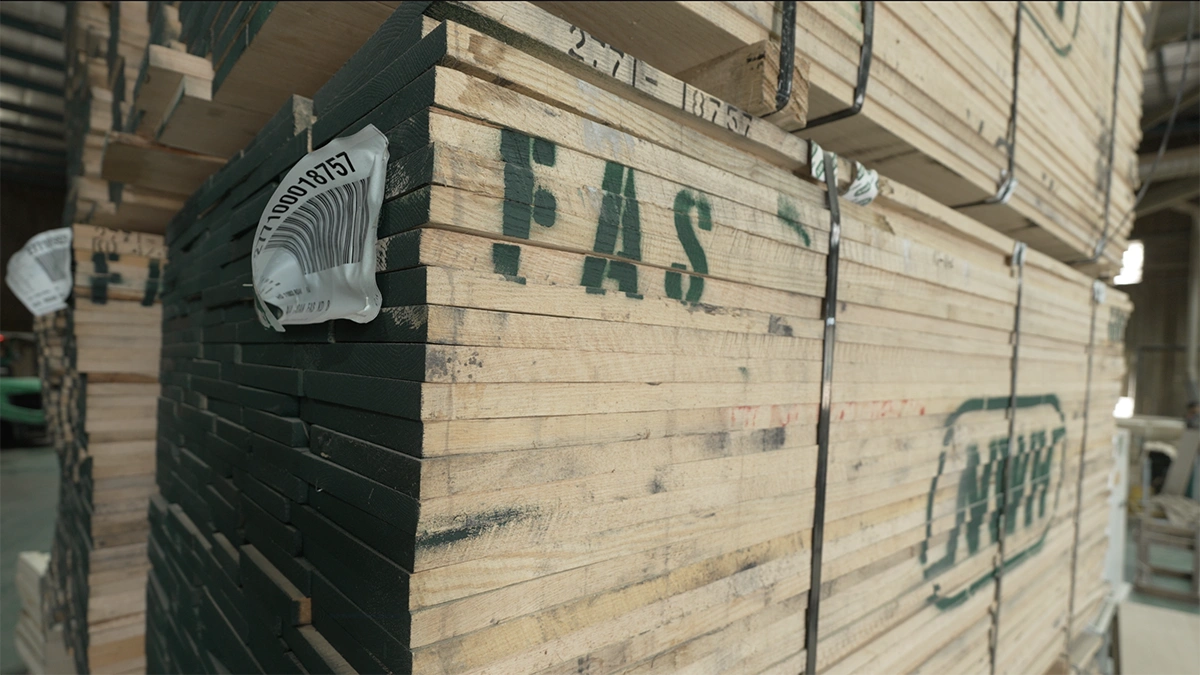
FAS Grade 4/4 North American White Oak Lumber for Premium Doors
Certified FAS grade 4/4 White Oak lumber from Ohio—offering exceptional clear-face yields and structural stability for premium interior door production.
Defining the Ultimate Benchmark: Technical Anatomy of the FAS Lumber Grade
Within the international hardwood lumber trade, the term “FAS” is not an arbitrary marketing buzzword or a vague synonym for “premium quality.” It represents the highest official commercial grade defined by the strict, mathematically quantified framework of the NHLA (National Hardwood Lumber Association). For a piece of lumber to receive the official FAS stamp, it must pass rigorous physical measurements and satisfy three uncompromising core metrics:
The Three Hard Metric Indicators
- Indicator I: Strict Minimum Board Dimensions: Short fall-down pieces or narrow trimmings can never achieve FAS status, regardless of how visually flawless they may be. The board must meet or exceed a strict physical envelope:
• Minimum Width: Must be ≥ 6 inches (approx. 15.2 cm).
• Minimum Length: Must be ≥ 8 feet (approx. 2.44 meters). - Indicator II: Minimum 83.33% Two-Sided Clear-Face Yield: The grading inspection requires a precise mathematical calculation based on the board’s Surface Measure (SM). The fundamental formula dictates:
Surface Measure (SM) × 10 = Total Required Clear-Face Cutting UnitsThe cumulative area of “completely flawless, knot-free, split-free” clear wood sections must yield between 83.33% (10/12) and 100% of the total board area. Crucially, the board must pass this 83.33% threshold on both faces independently—this two-sided mandate is the absolute differentiating factor separating FAS from S&B grades, which only require a perfect front face.
- Indicator III: Substantial Minimum Cutting Sizes: To prevent inspectors from accumulating the required 83.33% yield using small, fragmented sections of clear wood, the NHLA mandates strict minimum dimensions for each individual clear-face cutting unit. Each individual matrix cut must meet a substantial size envelope:
• Standard Option A: Minimum 4 inches wide × 5 feet long.
• Standard Option B: Minimum 3 inches wide × 7 feet long.