On March 4, 2025, China’s General Administration of Customs issued a sudden ban on U.S. log imports, sending a geopolitical shockwave through the world’s largest veneer processing hub within 24 hours. In B2B supply chains, orders represent binding long-term commitments; failure to deliver means losing clients forever. Amid this high-stakes geopolitical fallout, China officially lost its crown in veneer manufacturing. The nation stepping up to claim the throne is Vietnam—the silent winner that executed a massive supply chain relocation in just months. This is far more than a simple relocation of factories; it marks the most radical realignment of the global wood veneer sector in three decades.

1. The Collapse of the Trust Chain: Why Supply Chains Aren’t Returning to China
Industry analysts initially wondered: “Since tariffs temporarily eased between May and the end of 2025, why didn’t the veneer processing chain move back to China?” The reality is unforgiving: modern supply chains are built entirely on trust. When policies become unpredictable and geopolitical tail risks loom large, corporate risk aversion overrides short-term financial incentives.
Geopolitical disruptions trigger irreversible supply chain shifts due to three critical friction points:
- Prohibitive Re-entry Costs: Once factories are dismantled and heavy machinery is liquidated, the capital expenditures to return are net-negative.
- Talent Migration: During cross-border shifts, core technical experts and management teams quickly integrate into the new ecosystem.
- Irrevocable Loss of Buyer Confidence: Western buyers have lost faith in “Made in China” due to policy and delivery risks, making buying decisions permanent.
Vietnam’s rapid, blitzkrieg-style transition was fueled by over 30 years of established woodworking infrastructure in its southern hubs like Binh Duong, Dong Nai, and Long An. As Chinese operations paralyzed, Vietnam seamlessly absorbed advanced machinery, master technicians, managers, and operational expertise to ensure uninterrupted execution.
2. A New Global Duopoly: US Ultra-Premium vs. Vietnam’s Value Supremacy
The global wood veneer landscape has consolidated into a highly polarized duopoly. The United States retains an absolute lock on ultra-premium segments through domestic sourcing advantages. Veneer slicing requires immediate, on-site processing right after harvesting; the color uniformity, luster, and grain clarity of freshly cut logs cannot survive long ocean transit. As the native source for White Oak, Red Oak, and Black Walnut, American manufacturers like M. Bohlke Veneer Corp. remain uncontested at the absolute top of the market.
Conversely, Vietnam dominates the volume-driven mid-to-high-end global market, meeting the massive demand from furniture brands and commercial interior designers for cost-efficient veneer. Raw logs from the US, Europe, and Africa pour into Vietnam’s bonded warehouses, where tax exemptions on processing and re-exporting maximize margins.
Dismissing Vietnam’s rise as merely capitalizing on “cheap labor” fundamentally misunderstands its industry moat. In fact, factoring in log procurement and ocean freight, manufacturing in Vietnam is not inherently cheaper than in the US. Vietnam’s true competitive edge lies in its hyper-efficient industrial ecosystem and unprecedented yield optimization.
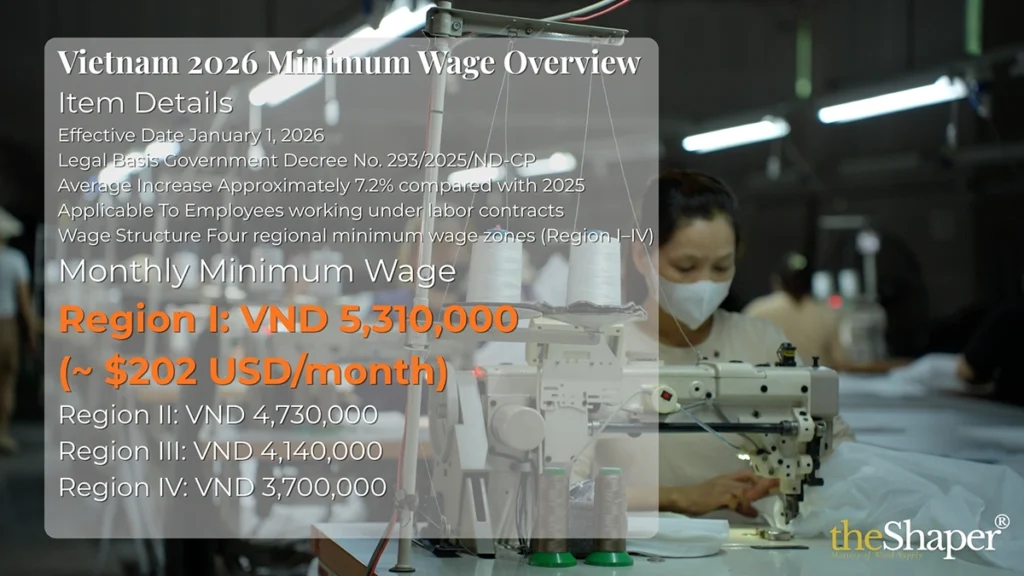
3. Beyond Low Cost: Unmatched Labor Productivity and Wage Optimization
Vietnam’s veneer dominance is anchored by an incredibly efficient labor framework:
- World-Class Manufacturing Output: Vietnamese workers exhibit exceptional skill and stamina, consistently maintaining high-volume outputs and precise quality yields under rigorous production schedules.
- Highly Scalable Cost Structures: Compared to Western economies and China, the total labor cost remains remarkably agile and competitive.
4. The Ultimate Moat: Maximizing Log Recovery Value
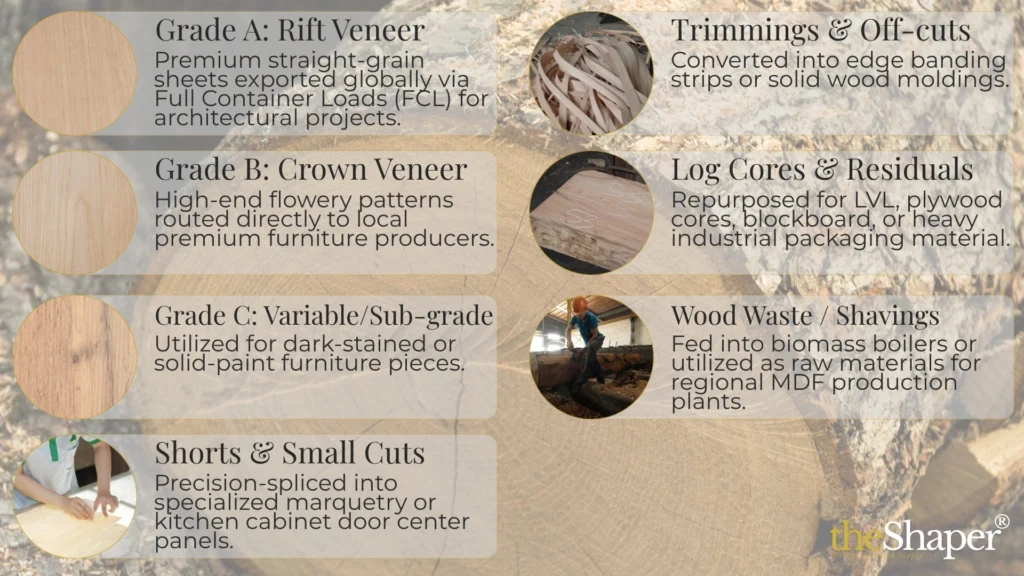
The primary secret of industrial B2B veneer processing is simple: focus shifts from “cost per square meter” to “Total Log Value Recovery”. In the US, high labor costs make sorting and splicing short-length down-grades financially unviable, forcing sub-grades into waste. In Southern Vietnam, a hyper-concentrated downstream network completely eliminates waste, turning every millimeter of a raw log into revenue:
| Log Yield Segmentation | Vietnam’s Zero-Waste Downstream Channels |
|---|---|
| Grade A: Rift Veneer | Premium straight-grain sheets exported globally via Full Container Loads (FCL) for architectural projects. |
| Grade B: Crown Veneer | High-end flowery patterns routed directly to local premium furniture producers. |
| Grade C: Variable/Sub-grade | Utilized for dark-stained or solid-paint furniture pieces. |
| Shorts & Small Cuts | Precision-spliced into specialized marquetry or kitchen cabinet door center panels. |
| Trimmings & Off-cuts | Converted into edge banding strips or solid wood moldings. |
| Log Cores & Residuals | Repurposed for LVL, plywood cores, blockboard, or heavy industrial packaging material. |
| Wood Waste / Shavings | Fed into biomass boilers or utilized as raw materials for regional MDF production plants. |
By monetizing every single layer of the log, Vietnamese factories offset the raw material costs of Grade A premium veneer, giving them an aggressive pricing advantage in global markets.
5. Consolidation of Scale: theShaper’s Mega-Capacity Ecosystem
In a B2B market prioritizing cost-efficiency and supply chain resilience, theShaper has aggressively consolidated Vietnam’s premier veneer processing titans—Phu San, Kim Cu Thai, and QingShan. This strategic alliance commands over 50% of Vietnam’s entire wood veneer capacity. This massive economies of scale creates an unmatched delivery moat and a powerful quality control filter: with such a massive production baseline, theShaper can meticulously extract top-tier, defect-free premium veneers from high-volume runs, reserving them for discerning clients while cross-subsidizing costs via its volume matrix.
6. Strategic Outlook: Vietnam’s Dominance is Unshakable for the Next Decade
While trade wars lit the fuse, China’s sudden domestic policy shifts shattered global supply chain confidence, forcing a permanent relocation. Vietnam successfully capitalized on this by blending advanced machinery, veteran technical talent, and an unmatched downstream network. Supported by optimal log recovery value and mega-capacity aggregators like theShaper, Vietnam’s crown as the undisputed king of veneer production is secured for the next 10 years.
2. China Import Prohibitions on U.S. Timber: Xinhua News Agency (2025)
3. Global Wood Veneer Manufacturing Analysis & Rankings: ProcurementIQ Market Intelligence Report